Kestrel Accountancy
Year-end paperwork that chases itself
An accountancy practice that spent a day a week chasing clients for documents now onboards clients and collects their paperwork automatically, with AI reading and filing every upload.
- Client
- Kestrel Accountancy
- Sector
- Accountancy & professional services
- Location
- York, UK
- Services
- Workflow automation, AI integration, Client portal
- Year
- 2026
01Overview
Six people, 238 tax returns, and a January that started in October.
Kestrel is a six-person accountancy practice in York. Most of its clients are sole traders and landlords who need a self-assessment return every year, and every return starts with the same paperwork: bank statements, P60s, rental statements and receipts.
Collecting that paperwork was the slowest part of the job, and almost all of it was done by hand. The practice asked us to automate the chasing without making it feel automated to clients.
- A new-client flow from enquiry form to signed engagement letter
- A document checklist for every client, built from their type of return
- Reminders by email and text that name only what is missing
- A private upload page for each client
- AI that reads, names and files every upload
- A year-end board and a Monday digest for the partners
02The challenge
A day a week on the phone, asking for the same five documents.
Onboarding a new client took fourteen manual steps across four tools: a web form, the practice software, a shared drive and a spreadsheet. It often took a fortnight.
Documents arrived by email, WhatsApp and post, with names like scan0042.pdf, so someone had to open every one to work out what it was and whose it was. Chasing lived in a spreadsheet and in people's heads, and between October and January it cost the team about a day every week.
03Onboarding on rails
One form starts everything. A person steps in once, to approve.
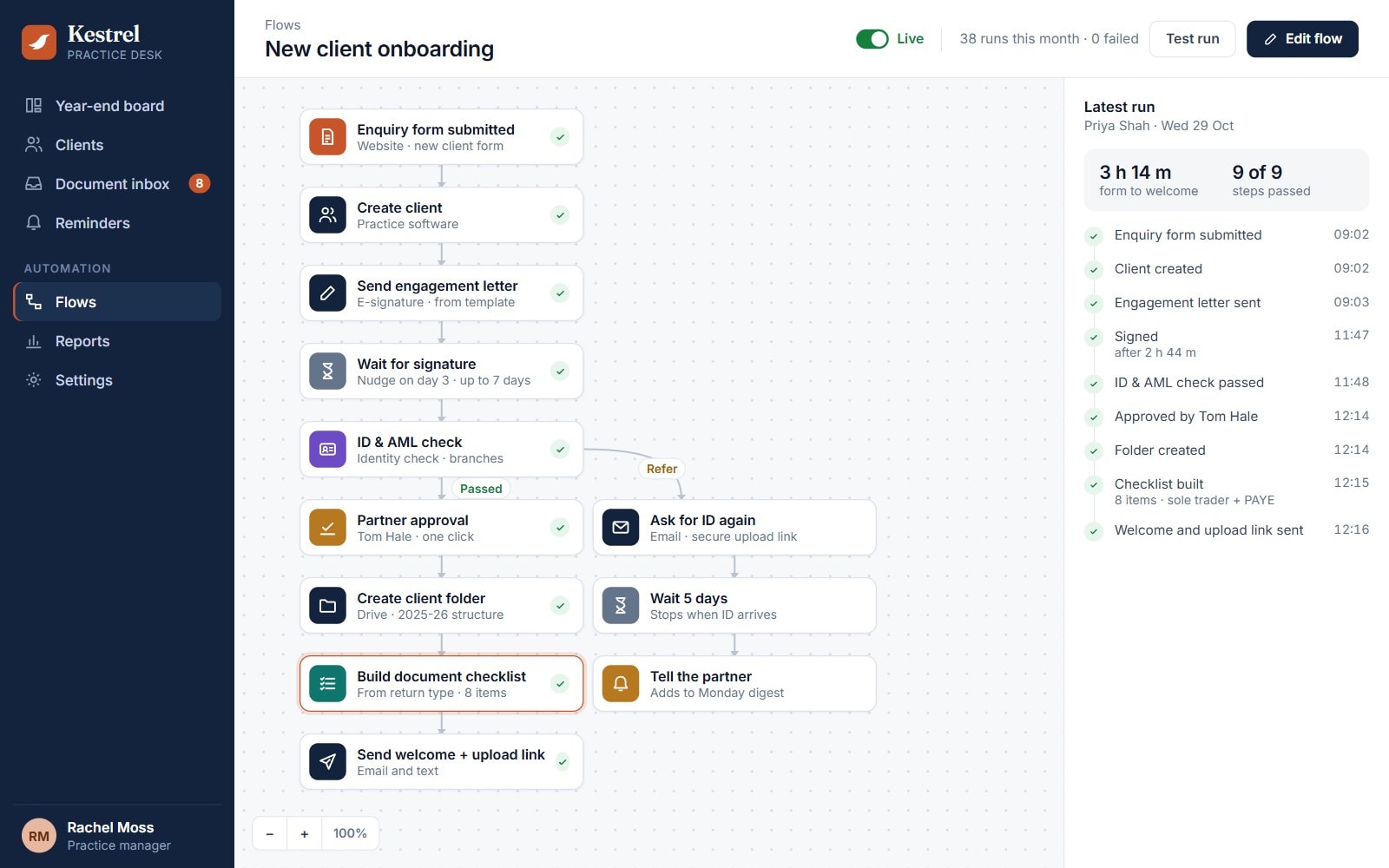
A new client fills in a single form. The flow creates them in the practice software, sends the engagement letter for e-signature, runs the ID and anti-money-laundering check, makes their folder and builds their document checklist. A partner approves in one click, and the client gets a welcome message and their upload link, usually the same day.
If the ID check needs a second look, the flow asks the client again and tells the partner, instead of stalling quietly.
04The chase
Polite, persistent, and quiet the moment the file arrives.
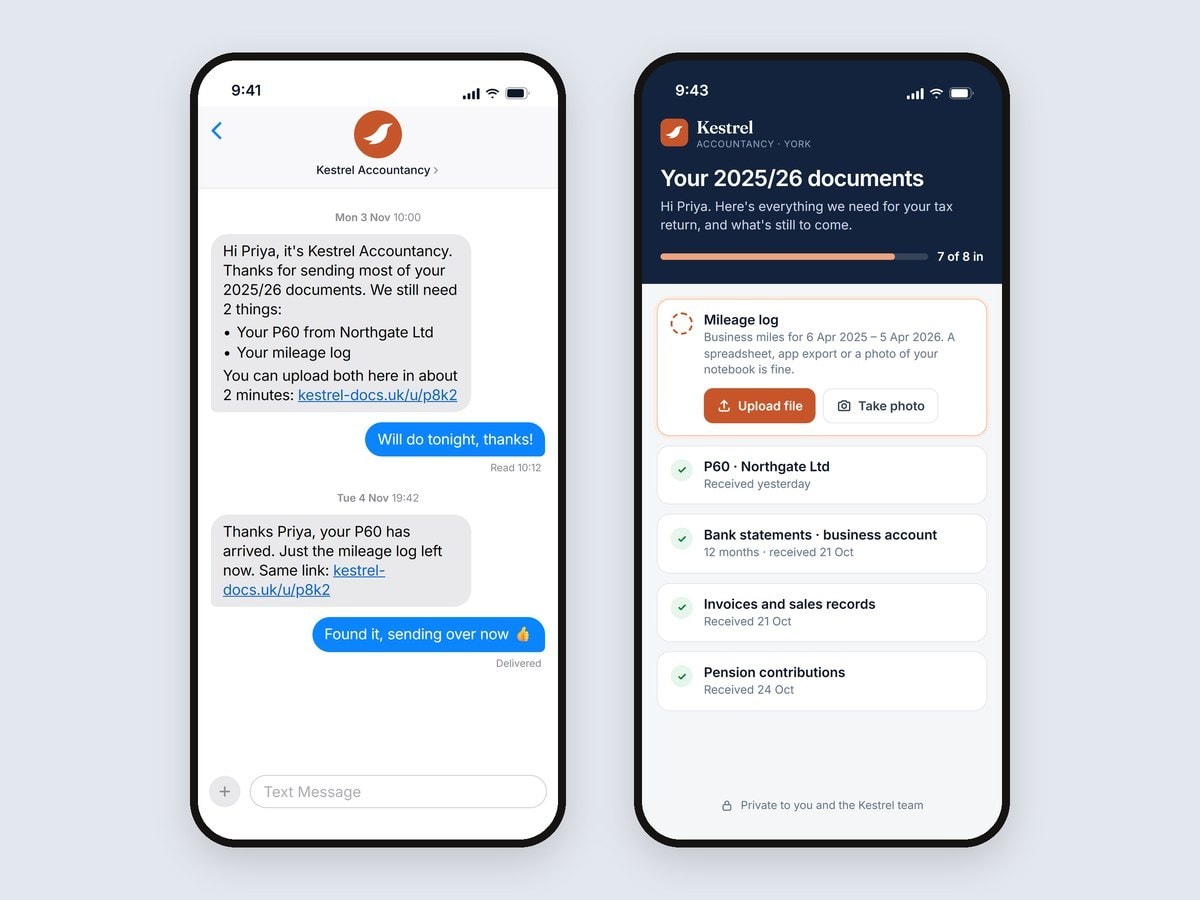
Each client gets a private page listing exactly what the practice still needs, where they can upload a file or take a photo. Reminders follow a schedule the practice set: an email after a week, a text after two, and a place on the team's call list after three.
Every reminder names only what is still missing, and it stops as soon as the file arrives.
05Sorted on arrival
AI reads every upload, and asks a person when it isn't sure.
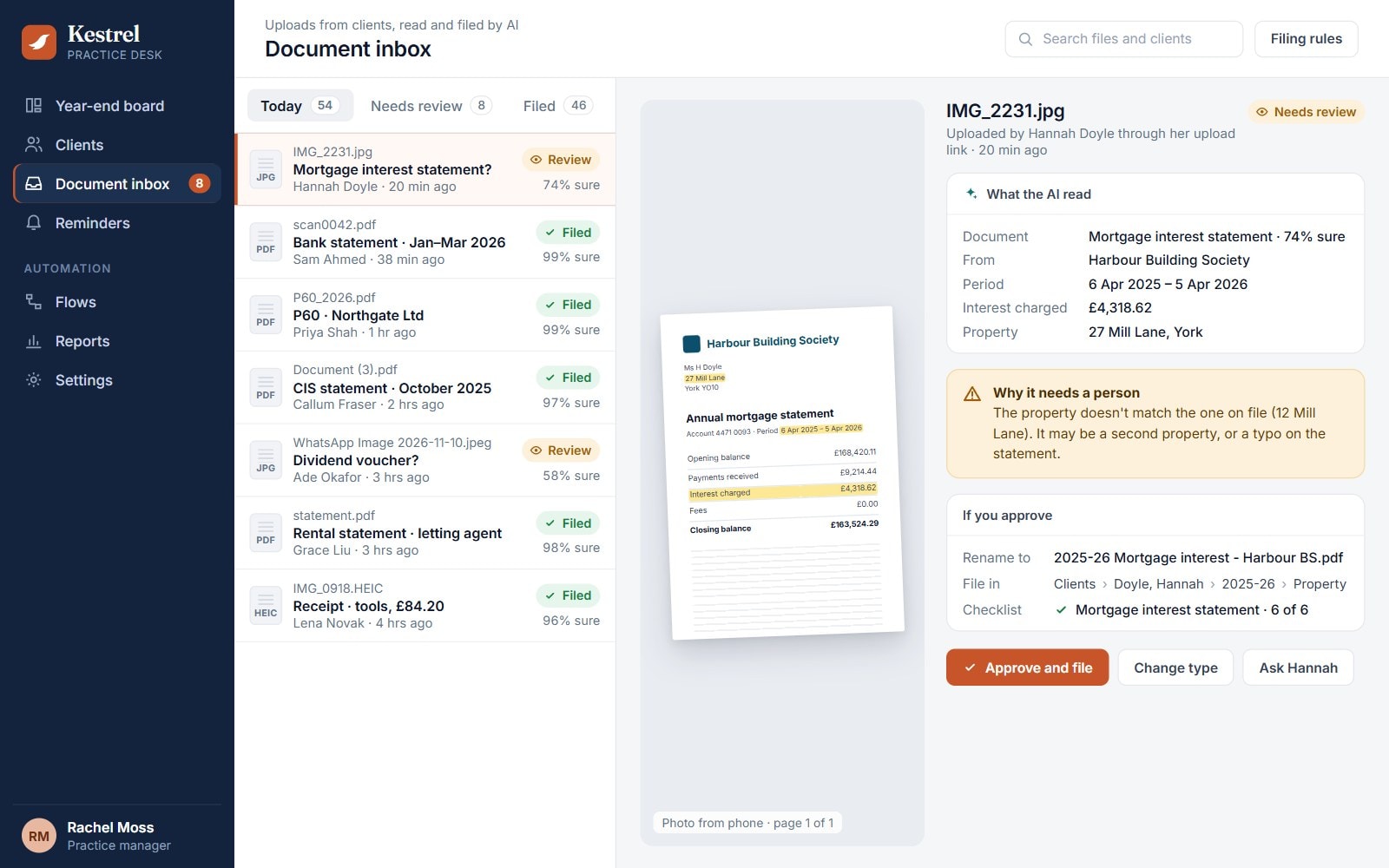
Every file a client sends is read by AI, which works out what it is, renames it to the practice's convention, files it in the right folder and ticks it off the checklist.
When it is less than sure, or something doesn't match what the practice already knows, such as a property address, the file waits in a review queue with the reason spelled out. Nothing is filed on a guess.
06The board
Every client, every document, on one screen.
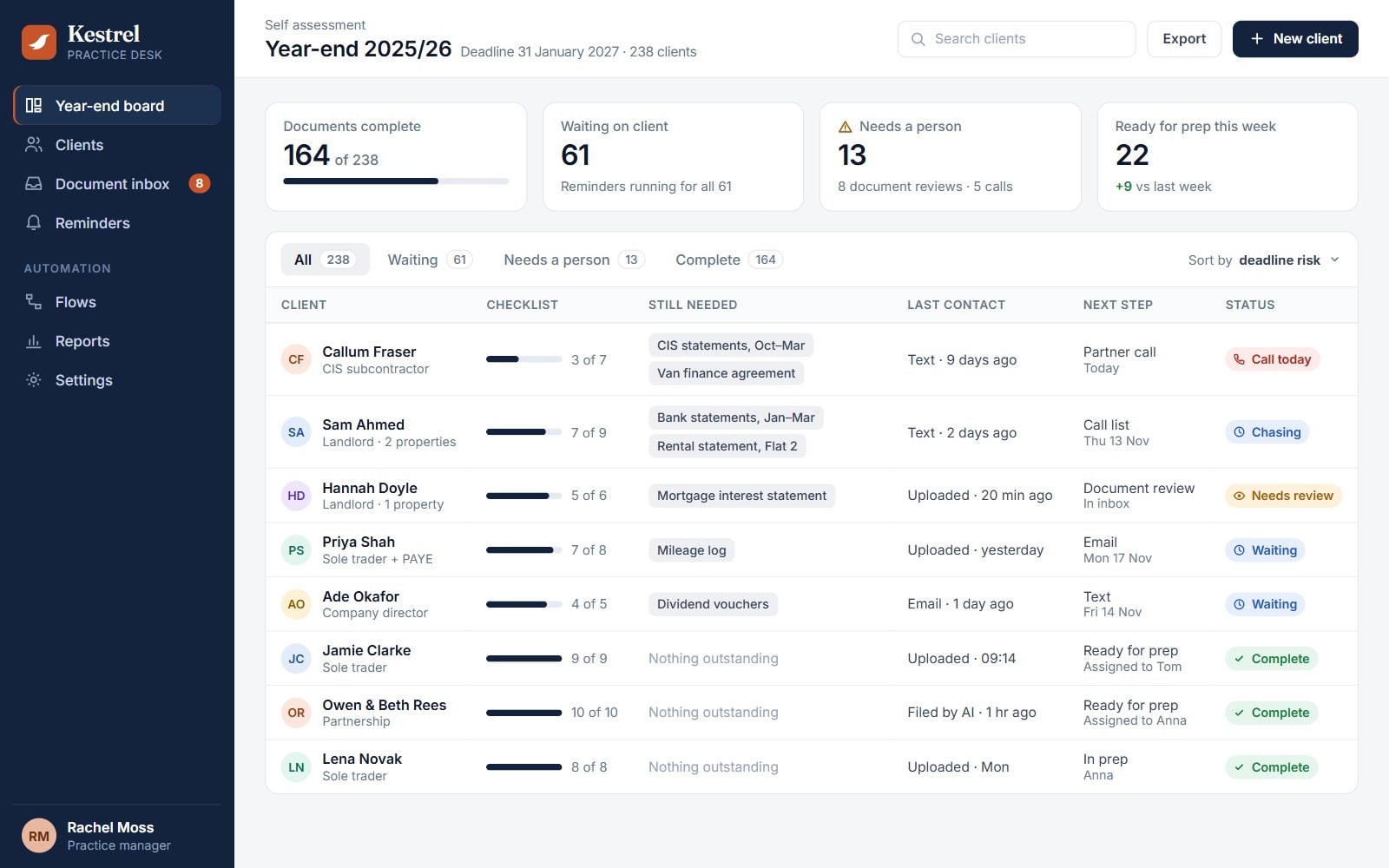
The team works from a year-end board that shows each client's checklist, what is still needed, the last contact and the next step. Anything that needs a person, whether a document to check or a call to make, rises to the top.
On Monday mornings the partners get a digest: returns ready to start, clients who have gone quiet and the week's deadlines.
07The result
The chasing still happens. The team just doesn't do it.
In the first filing season on the new system, most clients sent everything before a second reminder, and the team spent its January on returns instead of the phone.
- Chasing down from about a day a week to around an hour
- 71% of documents in before a second reminder
- New clients onboarded the same day instead of in a fortnight
08In numbers
“January used to mean a spreadsheet of who owed us what and an afternoon on the phone. Now the system does the asking, and we get on with the accounts.”
Want results like these?
Tell us about your business and we will show you what a project like this would look like for you.